The full cycle — from blending the mixture in production tanks to a finished, labeled canister — runs on our own line under continuous quality control. Below is a video from the filling line and a step-by-step breakdown of the process.
Video from the filling line: canister infeed, metered filling, capping and labeling.
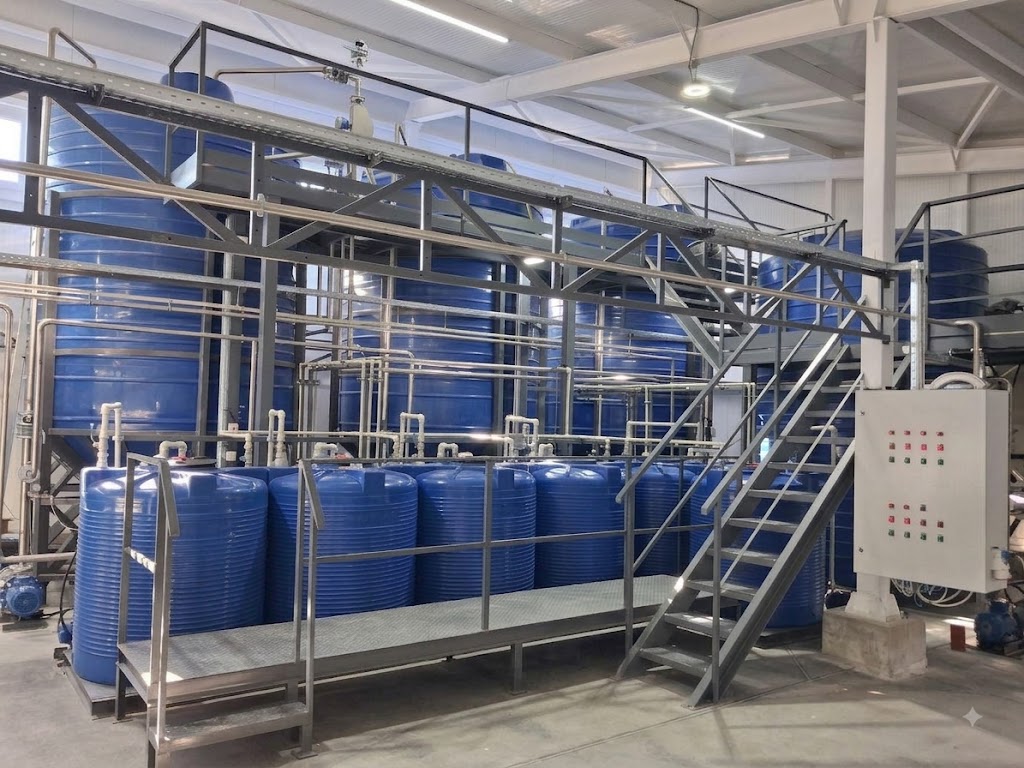
Before the product reaches the filling line, the finished formulation is blended in large production tanks (shown in the photo — the bank of tanks used for antifreeze and coolant). Components are dosed, mixed and pumped through piping directly to the filling area, which avoids unnecessary transfer and contact with the outside environment.
The finished blend is checked against key parameters (density, color, concentrate ratio) before it is released to the automatic filling line.
This description was put together from footage of the actual filling line at AutoChemSolution's production facility.
Empty canisters (5 L) are loaded onto a guided conveyor belt and move in a line toward the filling unit. Guide rails keep each canister upright and evenly spaced so it can't tip over or collide with the next one.
A multi-head filling unit fills several canisters at once with a precise, metered volume of liquid. Fill parameters — volume, recipe, speed, and unit count — are set by the operator on the line's touchscreen control panel.
An industrial touchscreen controller displays the selected recipe, current fill rate and a running count of finished units, letting the operator monitor production in real time and catch any deviation immediately.
Filled canisters pass under a capping head that automatically screws on and tightens the cap to a set torque — ensuring a tight seal and consistent closure quality on every unit.
Capped canisters move to the labeling station, where front and back labels are applied in sequence, showing product information, composition and the CRYONIX brand.
At the final stage, staff manually check the capping and label quality on every canister, then group the finished product and prepare it for packing and shipping.
On request, we provide additional materials for partners and distributors, and can arrange a visit to the facility.
Request a Quote